7 Types of Magnesium Supplements: A Beginner's Guide to Picking the Right One
Confused by magnesium types? Learn the key differences between glycinate, citrate, oxide, threonate, and more — plus how to choose the right form for your goals.

You’re standing in the supplement aisle, staring at a wall of magnesium bottles. Glycinate. Citrate. Oxide. Threonate. Taurate. They all say “magnesium” on the label — so what’s the difference, and does it actually matter?
Short answer: yes, it matters a lot. The word after “magnesium” tells you which compound it’s bonded to, and that changes everything — how well your body absorbs it, what it’s best used for, and whether it’ll send you running to the bathroom.
This guide breaks down the seven most common magnesium types in plain language so you can pick the right one for your goals — no chemistry degree required.
Disclaimer: This article is for educational purposes only and does not constitute medical advice. Always consult your healthcare provider before starting or changing any supplement regimen.
Why the Type of Magnesium Matters
Magnesium is involved in over 300 enzymatic reactions in your body — from muscle function and sleep to energy production and mood regulation. Around 50% of Americans don’t get enough from diet alone, which is why magnesium supplements are one of the most popular choices on the shelf.
But here’s the catch: not all magnesium supplements are absorbed equally.
Bioavailability — the percentage of magnesium your body actually absorbs and uses — varies dramatically between forms. Magnesium oxide, the cheapest option, has roughly 4% bioavailability. Magnesium glycinate can exceed 80%. That means you could take the same milligram dose of two different forms and get wildly different results.
The form also determines:
- What it’s best for — some forms target sleep, others target energy or brain health
- Side effects — certain forms cause digestive issues, others are gentle
- Cost — premium forms like threonate cost significantly more than oxide
Understanding these differences saves you money and helps you actually get the benefit you’re looking for.
The 7 Most Common Magnesium Types
Magnesium Glycinate
Best for: Sleep, anxiety, sensitive stomachs
Magnesium glycinate is magnesium bonded to glycine — an amino acid that has calming properties on its own. This makes it a double win for relaxation and sleep support.
It’s one of the most bioavailable forms available, meaning your body absorbs a high percentage of what you take. It’s also one of the gentlest on the digestive system, making it a solid choice if other forms have caused stomach upset.
The trade-off: It’s a premium-priced option. You’ll pay more per serving than citrate or oxide, but you’re getting significantly better absorption and fewer side effects.
Who should consider it: Anyone dealing with stress, poor sleep, or muscle tension — especially if you have a sensitive stomach.
Magnesium Citrate
Best for: General wellness, mild constipation relief
Magnesium citrate is one of the most widely available and well-studied forms. It has good bioavailability and is reasonably priced, making it a popular all-rounder.
It does have a mild laxative effect, which is a feature or a bug depending on your situation. If you tend toward constipation, citrate can help. If you don’t, you might want to start with a lower dose and see how your body responds.
The trade-off: The laxative effect can be disruptive for some people, and some research suggests it may interfere with sleep if taken close to bedtime.
Who should consider it: People looking for a solid general-purpose magnesium at a reasonable price — particularly if regularity is a bonus.
Magnesium Malate
Best for: Energy, muscle pain, fatigue
Magnesium malate pairs magnesium with malic acid — a compound your body naturally produces during energy metabolism. This makes it a popular choice for people dealing with chronic fatigue or muscle soreness.
It has high bioavailability and is gentle on the stomach. Some preliminary research suggests it may be particularly helpful for people with fibromyalgia-related pain, though more studies are needed.
The trade-off: It’s less studied than glycinate or citrate for sleep and anxiety benefits. If those are your primary concerns, another form may serve you better.
Who should consider it: People who feel chronically tired or deal with muscle pain and want an energizing form of magnesium.
Magnesium L-Threonate
Best for: Brain health, memory, cognitive function
Magnesium L-threonate is the newer kid on the block, developed by MIT researchers. Its claim to fame is that it’s one of the few forms shown to effectively cross the blood-brain barrier, potentially increasing magnesium levels in the brain.
Early research suggests it may support memory, learning, and overall cognitive function. It’s become popular in the nootropics community for this reason.
The trade-off: It’s the most expensive form on this list, and the research — while promising — is still limited compared to glycinate or citrate. Each capsule also contains less elemental magnesium, so you may need more capsules to hit your target dose.
Who should consider it: People specifically interested in cognitive support, brain fog, or age-related memory concerns.
Magnesium Taurate
Best for: Heart health, blood pressure, exercise recovery
Magnesium taurate combines magnesium with taurine — an amino acid that supports cardiovascular function. Research suggests this form may help with blood pressure regulation and heart rhythm.
It’s well-absorbed and gentle on the digestive system. Like glycinate, the amino acid pairing (taurine) has its own calming effects, making this a decent option for anxiety as well.
The trade-off: It’s in the premium price range and less widely available in stores compared to citrate or glycinate.
Who should consider it: People with cardiovascular concerns or those looking for a form that supports both heart health and relaxation.
Magnesium Oxide
Best for: Constipation relief (not great for much else)
Magnesium oxide is the most common form you’ll find in drugstores — and unfortunately, one of the least effective for addressing deficiency. Its bioavailability is estimated at just 4%, meaning your body barely absorbs it.
Where it does shine is as an osmotic laxative. It draws water into the intestines, which can provide effective short-term constipation relief. It’s also the cheapest option by far.
The trade-off: If your goal is to raise your magnesium levels, oxide is a poor choice. Most of what you take passes straight through. It can also cause significant GI distress — cramping, bloating, and diarrhea.
Who should consider it: People who specifically need a laxative effect. For anything else, spend a little more on a better-absorbed form.
Magnesium Lactate
Best for: Large doses, sensitive digestion
Magnesium lactate is magnesium bonded with lactic acid. It’s well-absorbed and notably gentle on the stomach, which makes it a practical choice when you need to take higher doses — such as during deficiency recovery.
It’s less popular than glycinate or citrate but deserves more attention for people who need consistent, high-dose supplementation without digestive side effects.
The trade-off: It doesn’t have the targeted benefits of specialized forms like threonate (brain) or taurate (heart). It’s a solid workhorse, not a specialist.
Who should consider it: People who need higher magnesium doses and want to minimize stomach issues.

Quick Comparison Table
| Form | Best For | Absorption | GI Friendly? | Price |
|---|---|---|---|---|
| Glycinate | Sleep, anxiety, muscle tension | High (80%+) | Very gentle | $$$ |
| Citrate | General wellness, constipation | High | Mild laxative | $$ |
| Malate | Energy, muscle pain, fatigue | High | Gentle | $$ |
| L-Threonate | Brain health, memory | Moderate | Gentle | $$$$ |
| Taurate | Heart health, anxiety | High | Very gentle | $$$ |
| Oxide | Constipation only | Very low (~4%) | Harsh | $ |
| Lactate | High-dose supplementation | High | Very gentle | $$ |
How to Choose: Match Your Magnesium to Your Goal
Still not sure? Here’s the simplest way to decide — start with your primary goal:
- “I want better sleep” → Magnesium glycinate or taurate, taken 30-60 minutes before bed
- “I need more energy” → Magnesium malate, taken in the morning
- “I’m dealing with brain fog” → Magnesium L-threonate
- “I need help with constipation” → Magnesium citrate or oxide
- “My doctor said I’m deficient” → Magnesium glycinate or citrate for best absorption
- “I want heart health support” → Magnesium taurate
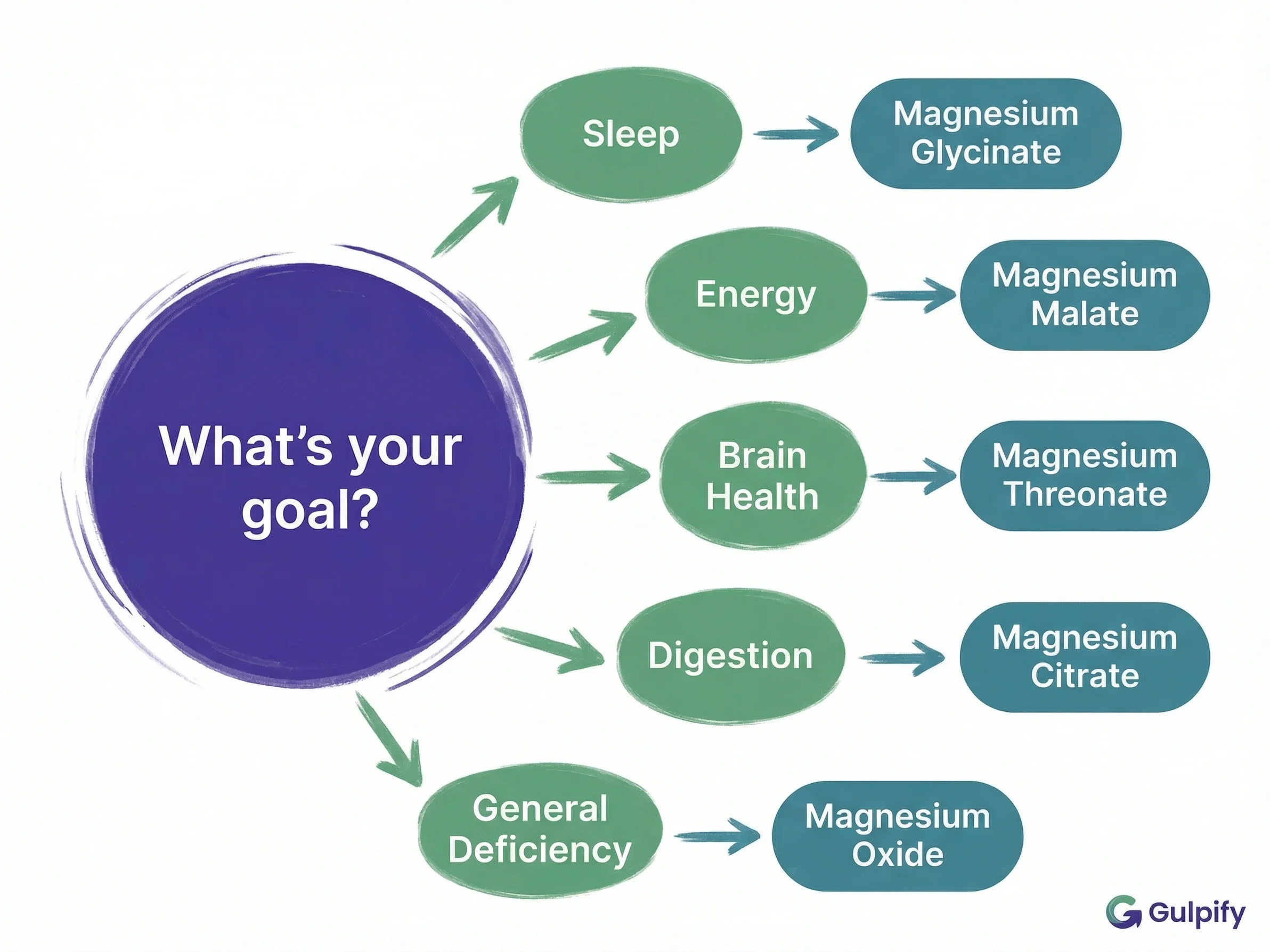
If you’re taking magnesium for the first time, glycinate is the safest starting point for most people — good absorption, minimal side effects, and broad benefits.
Once you’ve picked your form, the next challenge is actually remembering to take it consistently. This is where a tool like Gulpify can help — it lets you track exactly which magnesium form you’re taking, schedule your doses around meals or bedtime, and see whether your adherence is actually improving how you feel over time.
How Much Magnesium Do You Need?
The Recommended Dietary Allowance (RDA) for magnesium depends on your age and sex:
- Men (19-51+): 400-420 mg/day
- Women (19-51+): 310-320 mg/day
- Pregnant women: 350-360 mg/day
This includes magnesium from both food and supplements. Most people get some magnesium from diet — dark leafy greens, nuts, seeds, and whole grains are good sources — so your supplement dose doesn’t need to cover the full RDA.
The NIH sets the Tolerable Upper Intake Level at 350 mg/day from supplements alone. Going above this can cause diarrhea, nausea, and cramping — particularly with poorly absorbed forms like oxide.
A practical tip: Your body absorbs magnesium better in smaller amounts. If you’re taking 300+ mg daily, splitting it into two doses — morning and evening — can improve absorption and reduce any digestive side effects. An app like Gulpify makes split dosing easy with separate reminders for each dose so nothing slips through the cracks.

Key Takeaways
- The form of magnesium matters — bioavailability ranges from ~4% (oxide) to 80%+ (glycinate), so the type you choose dramatically affects how much your body actually uses.
- Glycinate is the best all-rounder — high absorption, gentle on the stomach, and supports sleep and relaxation. It’s the safest starting point for most beginners.
- Match the form to your goal — malate for energy, threonate for brain health, taurate for heart health, citrate for general use or constipation.
- Avoid oxide for deficiency correction — it’s cheap but barely absorbed. Save it for constipation relief only.
- Stick to 350 mg/day from supplements unless your doctor advises otherwise, and consider splitting into two doses for better absorption.
- Consistency matters more than perfection — the best magnesium supplement is the one you actually take every day. Track your intake and pay attention to how different forms make you feel.
Sources
- NIH Office of Dietary Supplements. “Magnesium — Fact Sheet for Health Professionals.” ods.od.nih.gov
- Institute of Medicine. Dietary Reference Intakes for Calcium, Phosphorus, Magnesium, Vitamin D, and Fluoride. National Academies Press, 1997. Link
- Schwalfenberg GK, Genuis SJ. “The Importance of Magnesium in Clinical Healthcare.” Scientifica, 2017; 2017:4179326. doi:10.1155/2017/4179326
- Firoz M, Graber M. “Bioavailability of US commercial magnesium preparations.” Magnesium Research, 2001; 14(4):257-262. PubMed
- Boyle NB et al. “The Effects of Magnesium Supplementation on Subjective Anxiety and Stress — A Systematic Review.” Nutrients, 2017; 9(5):429. doi:10.3390/nu9050429